Rye-spelt-wheat sourdough bread
It’s been a while since I last wrote about how to start or progress one’s baking adventure. I would like to share a new experience that I had – I created a new recipe.
Minęło trochę czasu odkąd ostatnio napisałem cokolwiek o rozpoczynaniu pieczenia lub rozwinięciu swoich umiejętności. Chciałbym podzielić się nowym doświadczeniem – stworzyłem nowy przepis.
You may remember from Challah or Pain Au Levain that we are having some attractions at school like the Valentine’s Day Cake Sale. This time we had an International Day to share information about our cultures. We’ve got kids at school from all around Europe, Africa, Asia, Australia, South America. Maybe Great Murica as well, I don’t know. Kids dress up, parents bring their local food. There was some pizza, goat meat in banana leaves, samosas, tiramisu, cheesecake, Cornish pasties, shepherd’s pie. And bread, surprise surprise. Guess who made it.
Originally I planned to make a Silesian sourdough, but I forgot that we planned to make one for our friends also having an International Day at another school nearby. I gave it a quick thought: I had nothing prepared, it was Thursday evening and I had to bake early enough to let the bread cool down. By nothing prepared I mean two starters a couple hours after feeding. I decided to make something up.
I’m not sure if I’m ready to make such stuff, but I guess there’s only one way to find out. For the last three-four months I’ve been reading the theory from two books: “Bread” by Jeffrey Hamelman and “Flour Water Yeast Salt” by Ken Forkish (sources). Only skipped the chapter about creating one’s own recipe… Sounds like this is the time to test things.
My assumptions and ideas:
- I want a bread that would look nice (out of a banneton),
- It needs to be tasty, potentially experimental mixture of flours,
- I want to have big percentage of a whole rye flour to make it dense and moist.
- I need about two kilograms of the dough,
- I want a lot of whole flours, so only strong wheat flour to make the dough elastic, not like clay,
- Since there is a lot of whole flour, the hydration needs to be reasonably high (I assumed 70% of flour weight),
- I don’t have a levain, so I need to use a mixture of mature sourdoughs (to have enough),
- 2% of flour weight would be salt,
- I know wholemeal calls for more water, but I was afraid it would go runny and flat, so I knew I want to do some stretch and folds during the two hour bulk proof (until it more or less doubles in volume),
- I also decided to make it by hand to feel the dough better and experience what it is like to work with it – just to know what to expect from it. Because a lot of kneading was not an option, I added 30 minutes of autolyze to make it easier,
- It had to rise overnight in the fridge – even if it is too wet, it will get stiffer, which in turn will prevent it from going fully flat in the oven.
Easy-peasy. I did initial maths:
100% flour + 70% water + 2% salt = 2 kg
I know, I ignored the sourdough above – I initially thought I could make a smaller loaf to leave at home. I didn’t, and it all landed in a big banneton.
172% x = 2 kg
x = 2 / 1.72 kg = 1.163 kg
70% x = 0.814 kg
2% x = 0.023 kg
Now let’s take into account that I’m baking bread, not running a home pharmacy.
Flour: 1200 g (100%)
Water: 850 g (70.8%)
Salt: 25 g (2%)
Let’s choose the flours:
- Strong wheat (as mentioned),
- Wholemeal rye (as mentioned),
- Dark spelt (because it’s neither wheat nor rye, and I happen to have it).
Initially I assumed it would be equal amounts, but:
- I only had 300 g dark spelt – I added 100 g light spelt flour,
- I accidentally added 500 g of wholemeal rye – there was only 300 g left for the strong wheat flour.
Let’s write it all down:
- 500 g whole rye flour
- 300 g dark spelt flour
- 300 g strong wheat flour
- 100 g light spelt flour
- 25 g salt
- 850 g water
Now to lift it, I needed some serious amount of sourdough. But at the same time it will have more time to rise in the fridge, so I finally used:
- 150 g mature strong wheat sourdough (Helena’s Kwiatek),
- 100 g mature whole rye sourdough.
I will repeat some of the above details now just to apply the template I normally use.
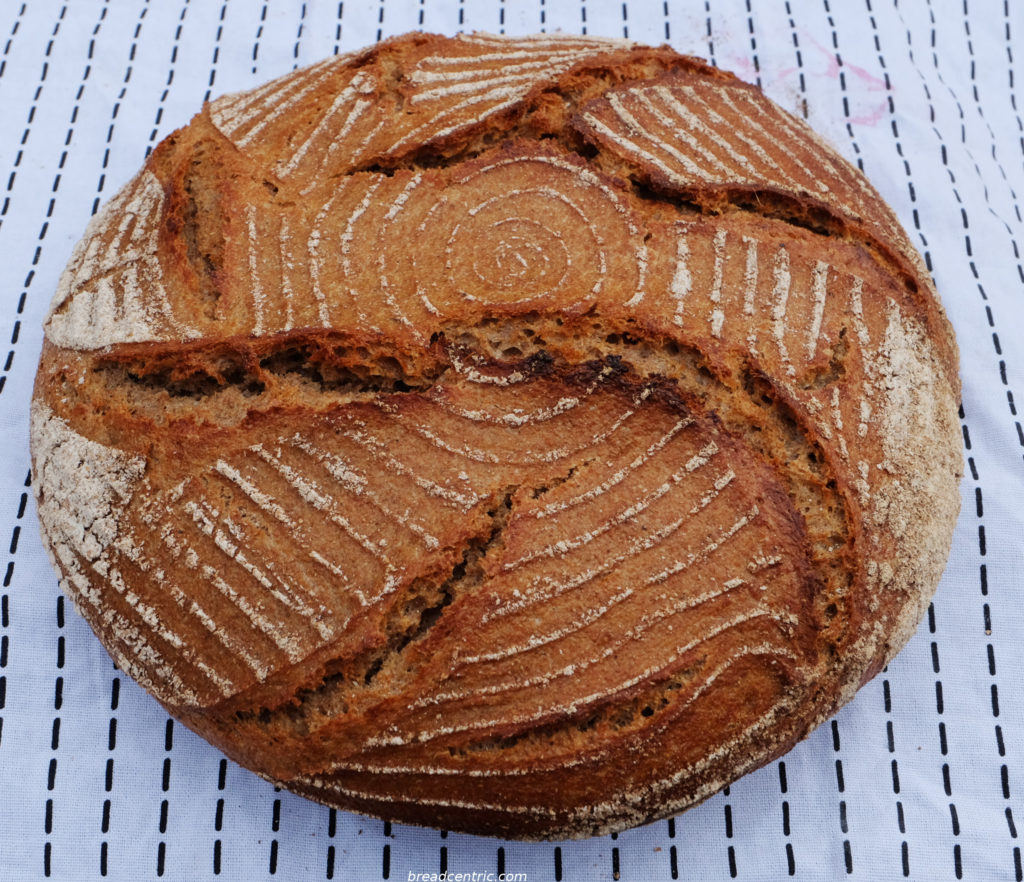
Rye-spelt-wheat bread
Planning
You need to have around 250 g of sourdough available, healthy and hungry (around 8 hours after feeding).
Two hours for bulk proof, a night in fridge (eight-nine hours), 50 minutes baking (40 if you make two loaves, not one). Twelve hours altogether.
If you plan to work by hand like me, have a large bowl (I used 10 litre bowl) and a small bowl of water to dip your hands every now and then. Wet hands don’t stick so much to the dough – it’s easier to work with it.
You’ll need a large banneton (to fit over two kilograms of dough).
Ingredients
This is 2300 grams of dough, so a lot of bread out of this.
- 500 g whole rye flour
- 300 g dark spelt flour
- 300 g strong wheat flour
- 100 g light spelt flour
- 25 g salt
- 850 g water
- 250 g mature sourdough(I used 150 g strong wheat and 100 g whole rye, both around 100% hydration)
Preparation
Mix flours with water – leave for 30 minutes for autolyze
Add sourdoughs and salt, mix. After a couple folds, I switched to a pincer method described by Ken Forkish
[youtube https://www.youtube.com/watch?v=HoY7CPw0E1s ]Leave for 2 hours, stretch and fold after 30 and 60 minutes (last hour of bulk proof without folding)
Dough is quite soft, sticky and loose, not much gluten action, but you will see it rise. This is the time to shape the loaf. I took the dough on a lightly floured surface, but it started sticking to it straight away. I think that next time I will start with a stretch and fold in the bowl, as you can clearly see how gluten begins to resist. Shape a round loaf
Put it into a heavily rye-dusted banneton, hide in a plastic bag and place in the fridge overnight (9 hours in my case). The banneton needs to be really heavily dusted, the dough will stick to it otherwise. Put some flour on top to prevent the dough from sticking to the bag
In the morning set the oven to 250 C (or as high as you can get) and stone/iron cast sheet in it (at least 40 minutes). If you don’t have one, it should be still fine, just make sure the crust doesn’t burn – I usually put an empty tray between the bread and the heating element to provide some heat screening.
I usually heat up using an upper & lower heating elements and switch for the lower one when I put the loaf in the oven. Know your ovenPut the dough straight out of the fridge on the stone, score and bake for 50 minutes. Provide a lot of steam when putting the loaf into the oven, but release it after 20-30 minutes of baking.
Let it cool on a cooling rack.
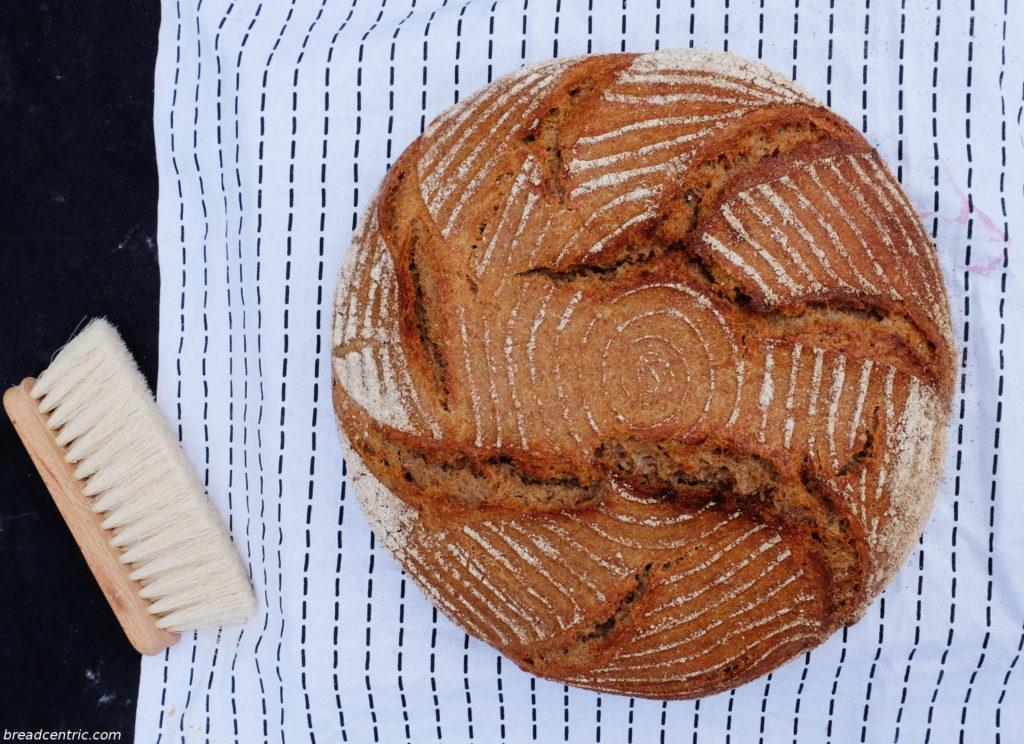
Rye-spelt-wheat bread
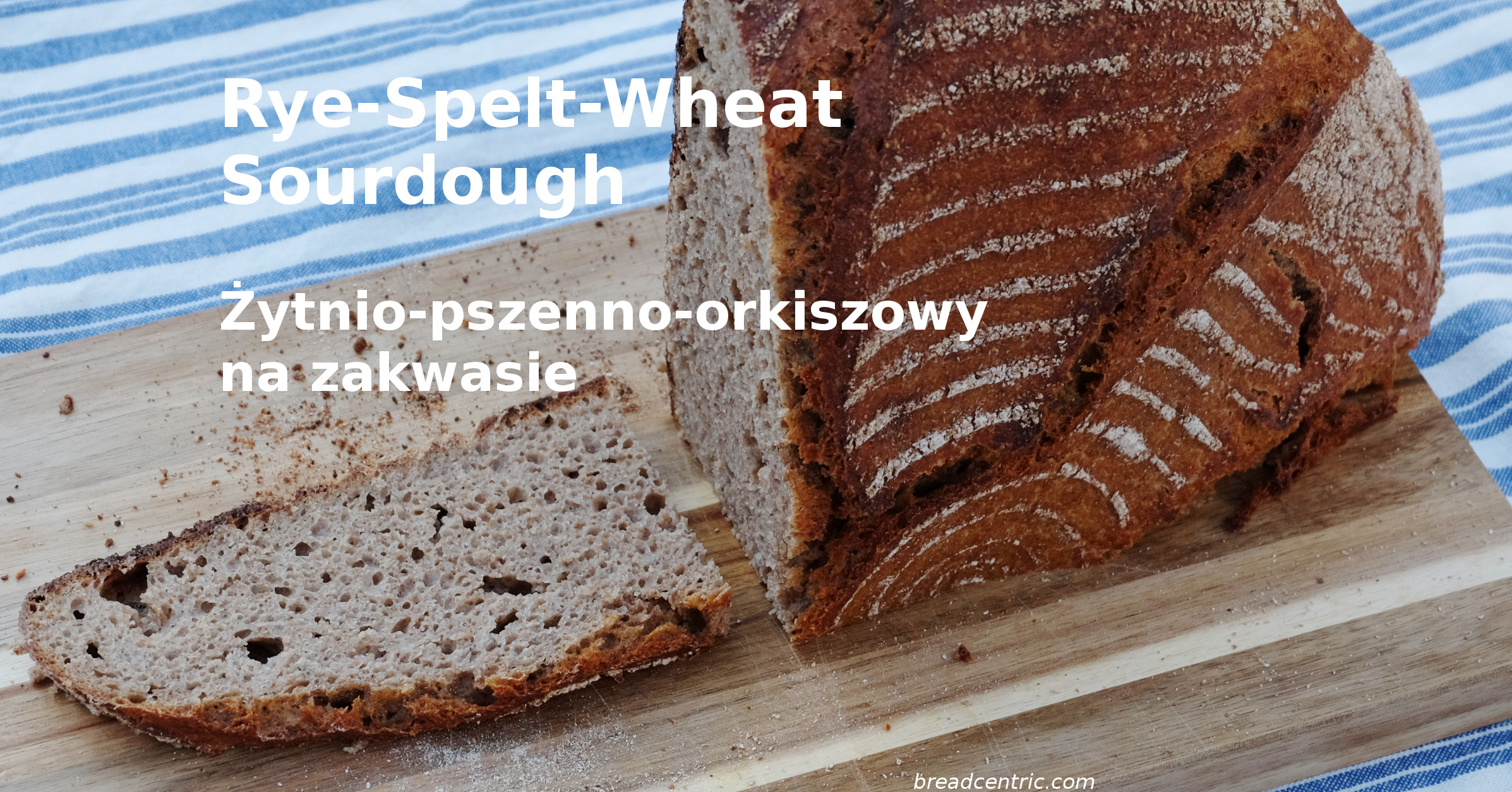
The bread was very nice, very moist. It expanded nicely in the oven, cracked in an unexpected way, maybe the crust formed too quickly, or maybe it was simply because there was a lot of rye and that’s what rye does. Or it had too much left to expand for the scoring that I gave.
At the International Day there wasn’t much interest in the bread during the event, but at the end the whole bread disappeared (people took it home, just like us). And it was quite enjoyable.
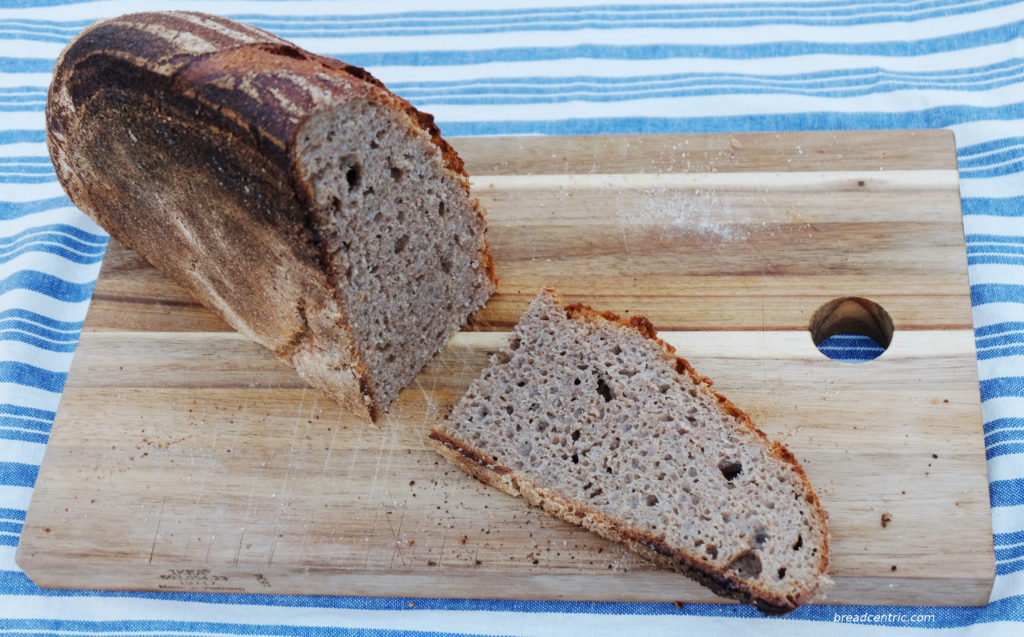
The crumb
Since this is a learning journey, here’s a couple things to try out:
- only light spelt flour – I’ve run out of the dark one, but event without it, I’m wondering what change this can cause
- perhaps 50 g less water – I’m not 100% convinced it requires changing, but maybe the dough would be a bit more manageable.
- take out of the fridge when the oven is heating up – maybe there will be less cracks (but then maybe it will go flat on the spot when taken out of the banneton)
- 5 g more salt (I was missing a bit)
- 400 g whole rye flour and 400 g strong wheat flour – maybe it will make the dough more manageable
Of course, you cannot make all the changes at once (you would not see the impact), but it is something to try.